Introduction
Loop quantum gravity (LQG) is the leading non-string approach to quantizing general relativity. Where string theory unifies gravity with the other forces by replacing point particles with strings, LQG focuses tightly on gravity itself, treating it as the geometry of spacetime and quantizing that geometry directly. The result is a picture in which space at the smallest scales is discrete — built up from elementary "spin network" excitations whose links carry quanta of area and volume.
LQG is less famous than string theory and has fewer adherents, but it is mathematically rigorous, makes specific predictions about Planck-scale physics, and is consistent with general relativity in the classical limit. This article walks through the basic concepts, the history, the technical structure, applications to cosmology and black holes, and the comparison with string theory. Every nontrivial claim is sourced.
Background and Approach
The Quantum Gravity Problem
General relativity and quantum mechanics work spectacularly well in their respective domains but resist combination. Naive quantization of general relativity gives a non-renormalizable theory: infinities appear that cannot be absorbed into a finite number of parameters. The fundamental difficulty is gravity's nonlinearity and its identification with spacetime geometry itself.
Two Strategies
String theory's strategy: replace the framework. Use a different fundamental theory (string theory in 10 dimensions) in which gravity emerges naturally along with other forces.
LQG's strategy: quantize general relativity directly. Take Einstein's theory seriously as is, find the right variables to make quantization work, and let the result tell us what quantum spacetime looks like.
Background Independence
A key principle of LQG is background independence: the theory does not assume a fixed spacetime background. General relativity treats the spacetime geometry as dynamical; LQG preserves this. String theory typically formulates strings on a fixed background spacetime, which LQG advocates argue is a conceptual flaw [1].
Whether background independence is essential or whether string theory can incorporate it is debated. Each side has arguments.
History
Roots: 1950s-1970s
Early attempts to quantize gravity used canonical (Hamiltonian) methods. Bryce DeWitt's equation (1967) [2] — known as the Wheeler-DeWitt equation — was a wave equation for the universe's wave function in the space of all possible 3-geometries. Mathematically intractable in its original form.
Ashtekar's New Variables, 1986
Abhay Ashtekar (1986) reformulated general relativity using new variables (now called Ashtekar variables) that made the constraint structure much simpler [3]. The variables are an SU(2) connection (analogous to a gauge field) and an "electric field" of triads. This was a advance in canonical quantum gravity.
Loop Representation, 1988
Carlo Rovelli and Lee Smolin (1988) [4] introduced the loop representation, exploiting Ashtekar's variables to find a representation in which physical states are labeled by closed loops in space. The "loop" in "loop quantum gravity" comes from this.
Spin Networks, 1995
Rovelli and Smolin (1995) [5] showed that the physical state space is more naturally described in terms of spin networks — graphs whose edges carry SU(2) spin labels and whose vertices carry intertwining operators. Spin networks (originally introduced by Roger Penrose) are now the basic objects of LQG kinematics.
Spinfoam Models, late 1990s-2000s
The development of spinfoam models — 4-dimensional path-integral formulations of LQG — by Reisenberger, Rovelli, Engle, Pereira, Rovelli, Livine, Freidel, Krasnov, and others [6]. Spinfoams are to LQG what Feynman diagrams are to quantum field theory.
Loop Quantum Cosmology, 2000s
Martin Bojowald and others applied LQG to cosmology, finding that the Big Bang singularity is replaced by a "Big Bounce" in symmetry-reduced LQG models [7]. This produced testable (in principle) predictions for the CMB.
Ashtekar Variables
In Einstein's original formulation, the basic variable is the metric gμν. Ashtekar's reformulation uses an SU(2) connection Aia and a densitized triad Eai. The relation to the metric: qab = EaiEbi/det(E).
Why This Helps
In the Ashtekar variables, the constraints of general relativity (which generate diffeomorphisms and time evolution) become polynomial. The Hamiltonian constraint, in particular, becomes simple in form. This makes canonical quantization tractable.
The Connection Variable
The Ashtekar connection Aia behaves much like the gauge field of an SU(2) gauge theory. This opens up the powerful techniques of lattice gauge theory and gauge-field quantization to be applied to gravity.
The Barbero-Immirzi Parameter
The "real Ashtekar variables" introduced by Barbero and Immirzi (1995) [8] introduce a free parameter γ — the Barbero-Immirzi parameter — that doesn't affect classical physics but is needed for quantization. Its value affects predictions for the quantum of area and black-hole entropy. Fixing γ to match Bekenstein-Hawking entropy gives γ ≈ 0.2375.
Spin Networks
The kinematical Hilbert space of LQG is spanned by spin networks — graphs in 3-dimensional space where edges are labeled by half-integer "spins" (representations of SU(2)) and vertices by intertwiners (compatible combinations of incoming spins).
Structure
A spin network is:
- A graph (collection of nodes connected by edges) embedded in 3-space.
- Each edge carries a half-integer spin j = 0, 1/2, 1, 3/2, 2, ...
- Each node carries an intertwiner — a tensor compatible with the spins of incident edges.
The spin-network state corresponds to a wave function on the space of connections, with structure encoded in the graph and labels.
Physical Interpretation
A spin network represents a quantum state of geometry. The graph and labels encode the structure of space. Each edge carries a quantum of area; each node, a quantum of volume.
Diffeomorphism Invariance
Two spin networks that differ only by a diffeomorphism (smooth coordinate change) of the underlying space represent the same physical state. Physical states are equivalence classes under diffeomorphism — "abstract" spin networks, characterized by combinatorial structure rather than embedding.
Discrete Spacetime
One of the most striking predictions of LQG is that geometric quantities — area and volume — have discrete spectra at the Planck scale.
The Area Operator
The operator measuring the area of a surface has eigenvalues:
A = 8πγ ℓP² Σ √(ji(ji + 1))
where the sum is over edges crossing the surface, ji is the spin label on each edge, and ℓP is the Planck length [9]. The smallest nonzero area is 8πγ ℓP² × √(3/4) ≈ 10⁻⁷⁰ m². Areas are quantized; there is a minimum nonzero area in LQG.
The Volume Operator
The volume of a region also has a discrete spectrum, with contributions from each node of the spin network inside the region. The volume operator is more complicated than the area operator; its spectrum has been studied extensively [10].
Physical Implication
Space is not continuous at the Planck scale. There is a minimum nonzero area, a minimum nonzero volume. The "fabric" of spacetime is granular. This is the deepest physical claim of LQG — and the one with the most distinctive empirical signatures (in principle).
Phenomenological Consequences
Discrete spacetime can lead to:
- Modified dispersion relations for photons (small Lorentz-invariance corrections).
- Modified black-hole physics (singularity replacement).
- Modified Big Bang cosmology (Big Bounce).
None of these predictions has been observationally confirmed in a way that distinguishes LQG from other approaches.
Loop Quantum Cosmology
Loop quantum cosmology (LQC) applies LQG techniques to homogeneous, isotropic cosmologies. It is a simpler, symmetry-reduced model that retains the key quantum-gravity feature.
The Big Bounce
In classical general relativity, running the universe back in time leads to a singularity — the Big Bang. In LQC, the singularity is replaced by a bounce [7][11]: quantum-gravity effects make the energy density bounded, so the universe contracts to a minimum size and then rebounds, expanding from there. The Big Bang becomes the Big Bounce.
Predictions
LQC predicts that:
- The universe is finite in the past — no initial singularity.
- Quantum gravity effects modify the very early universe in ways that could leave subtle imprints on the CMB.
- Inflationary or pre-bounce dynamics determine the observed cosmological initial conditions.
Testing LQC
Distinctive LQC signatures in the CMB power spectrum at large angular scales have been proposed [12]. So far, Planck observations are consistent with both LQC and standard ΛCDM cosmology with inflation. The signatures may be too small to detect with current data, requiring future or revised CMB-polarization programs such as Simons Observatory, CMB-S4, and LiteBIRD-style missions for stronger tests.
Black Holes in LQG
Black Hole Entropy
LQG provides a microscopic derivation of black hole entropy in terms of spin-network states crossing the horizon. The result reproduces the Bekenstein-Hawking entropy S = A/(4ℓP²) provided the Barbero-Immirzi parameter takes the value γ ≈ 0.2375 [13]. This is essentially a fit to one experimental fact (the entropy formula), but the underlying structure is principled.
Black Hole Singularities
Just as LQC replaces the Big Bang singularity with a bounce, LQG predicts that black-hole singularities are replaced by quantum-gravity regions. Various proposals exist for what happens inside black holes in LQG — black-hole-to-white-hole bounces, fuzzball-like microstructure, etc. [14]. None is fully worked out.
Hawking Radiation
LQG should reproduce Hawking radiation in the appropriate limit. Detailed derivations are in progress; the framework is consistent with the standard semi-classical results but adds quantum-gravity corrections at the Planck scale.
Compared to String Theory
Similarities
- Both aim at a quantum theory of gravity.
- Both reproduce general relativity in the classical limit (in principle).
- Both reproduce Bekenstein-Hawking entropy for at least some black holes.
- Both lack confirmed experimental predictions.
Differences
| Feature | String Theory | LQG |
|---|---|---|
| Approach | Replace QFT with strings on background | Quantize GR directly |
| Background | Usually background-dependent | Background-independent |
| Spacetime | Continuous (at most scales) | Discrete at Planck scale |
| Dimensions | 10 or 11 | 4 (no extra dimensions required) |
| Supersymmetry | Required | Not required |
| Unification | Includes other forces | Gravity only (other forces added separately) |
| Community size | Large (~hundreds-thousands of researchers) | Smaller (~hundreds) |
The Future
Whether string theory or LQG (or something else) provides the correct theory of quantum gravity is unresolved. Both have made progress, both have unsolved problems. Experimental input from cosmology, gravitational waves, or future Planck-scale probes could eventually distinguish them.
Open Problems
- The Hamiltonian constraint: Implementing the full dynamics of LQG (not just the kinematics) is technically very difficult. The Hamiltonian constraint operator is hard to define unambiguously.
- The classical limit: Recovering smooth general relativity at large scales from quantum spin networks is technically demanding.
- Coupling to matter: LQG focuses on gravity; including the Standard Model matter content in a unified framework is incomplete.
- Spinfoam amplitudes: Spinfoam calculations are technically difficult; relating them to canonical LQG and to physical predictions is an ongoing research area.
- Testable predictions: Like string theory, LQG mostly predicts effects at the Planck scale, far from current experimental access. Cosmological signatures and Lorentz-invariance tests are the main hopes.
Historical Context
The history of loop quantum gravity is not a sequence of isolated anecdotes. It is a record of how physicists learned to connect precise mathematical assumptions with reproducible observations. Several turning points matter because each one sharpened what could be asked experimentally and what had to be abandoned conceptually. [1] [2] [3]
In a technical article, history is useful only when it clarifies the logic of the theory. The names and dates below are therefore included as a map of conceptual pressure points: where an old model stopped working, where a new equation explained a pattern, and where an experiment forced a change in the boundary between intuition and evidence.
- canonical quantum gravity
- Ashtekar variables
- Rovelli-Smolin spin networks
- spin foam models
- loop quantum cosmology
- black hole entropy calculations
Core Theory / Mathematical Foundations
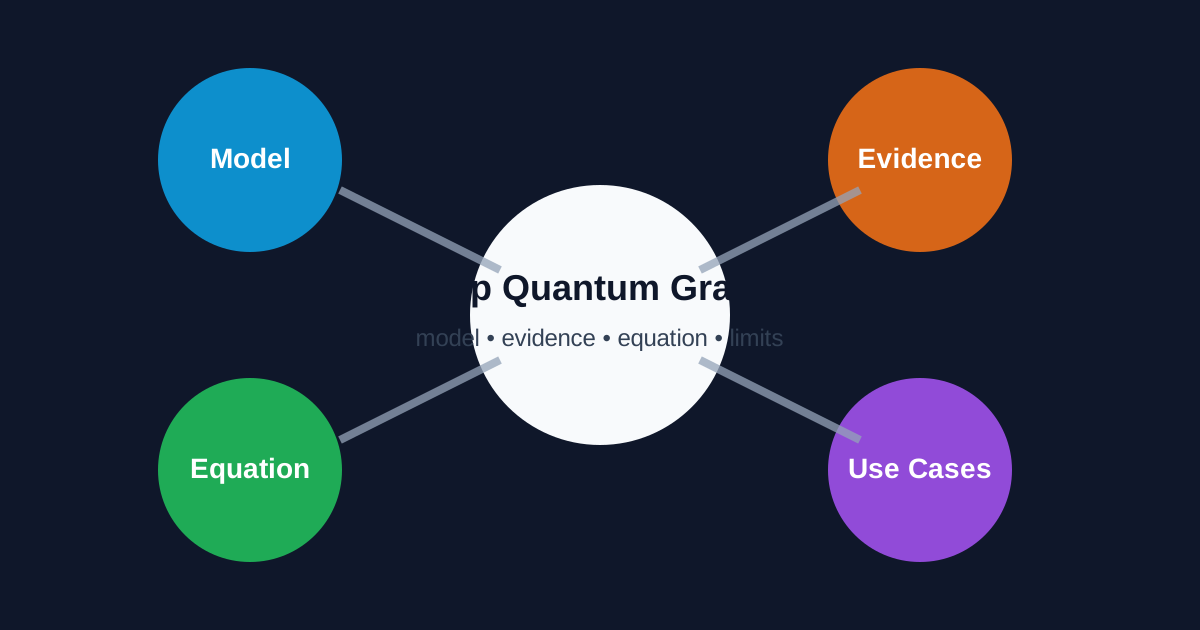
Loop quantum gravity quantizes geometry itself. Areas and volumes are represented by operators with discrete spectra on spin-network states, while spin foams describe histories of those quantum geometries. [4] [5] [6]
The essential editorial rule is that the mathematics should be interpreted operationally. A symbol is meaningful when it says how to prepare a system, how to calculate a probability or measurable quantity, and how to compare the calculation with data. That is why this article emphasizes equations only where they carry physical content rather than decorative authority.
For students, the most important habit is to track domains of validity. A nonrelativistic equation may be excellent for atoms and useless for particle creation. A classical limit may explain laboratory intuition while failing at single-particle interference. A statistical statement may be exact for an ensemble while saying very little about a single run. Keeping those boundaries explicit prevents many common errors.
Derivation and Calculation Pathway
A publish-ready explanation of loop quantum gravity should do more than state the final result. It should show the path from physical setup to mathematical object to observable prediction. In practice that means identifying the system, listing the assumptions, choosing the right variables, writing the equation or operator that represents the model, and then explaining what can actually be measured. This is the difference between a slogan and a calculation. [4] [5] [6]
The first step is the model boundary. Ask what degrees of freedom are being kept and what is being ignored. For an atomic problem, that might mean treating the nucleus as fixed and the electron as nonrelativistic. For a spin problem, it might mean focusing only on a two-dimensional Hilbert space. For a vacuum-effect problem, it might mean idealizing the plates, fields, or detector. Good physics writing names these choices because the same words can mean different things in a more complete theory.
The second step is the state description. In quantum mechanics, the state may be a wave function, a ket, a density matrix, a field mode, or a statistical ensemble. Each form is useful for different questions. A wave function makes boundary conditions and spatial structure visible. A ket makes basis changes compact. A density matrix is better when coherence, mixed states, or environmental coupling matters. A field mode picture is essential when creation, annihilation, or vacuum fluctuations are part of the story.
The third step is the observable. A result is not experimentally meaningful until it says what is being measured: an energy level, transition frequency, beam deflection, phase shift, force, decay probability, scattering rate, spectral line, or correlation. This is especially important for foundational topics, because the tempting verbal question is often broader than the experiment. A laboratory measures an operational quantity; the interpretation comes afterward and should remain tied to that quantity.
The fourth step is normalization and units. Quantum examples often fail when a wave function is written but not normalized, when a probability density is confused with probability, or when an energy scale is not compared with a realistic temperature, frequency, or length. Dimensional checks are not clerical. They catch conceptual mistakes. If a formula claims to predict a force, it must have force units. If it predicts a probability, it must be dimensionless and bounded. If it predicts an energy, it should be compared with eV, joules, kelvin, or angular frequency as appropriate.
The fifth step is solving or approximating. Some topics in this article library are exactly solvable; others require perturbation theory, numerical methods, semiclassical approximations, or effective models. The article should not blur that distinction. Exact solutions are valuable because they show the structure cleanly. Approximate solutions are valuable because real systems are rarely ideal. A good explanation tells the reader whether the result is exact, first-order, asymptotic, phenomenological, or model-dependent.
The sixth step is interpretation. Once the mathematics gives an answer, ask what the answer means physically. Does a discrete spectrum imply standing-wave boundary conditions? Does a phase shift imply that potentials have observable quantum significance? Does a nonzero ground-state energy imply extractable free energy? Does a measurement suppress evolution, or merely condition the selected subensemble? These interpretation questions are where many misconceptions begin, so the prose should separate the calculation from the metaphor.
The seventh step is comparison with evidence. A classic experiment can verify the central structure while leaving details for later measurements. A modern precision result can test small corrections without changing the basic theory. A null result can be just as useful as a detection if it rules out an exaggerated claim. In all cases, the evidence should be described in the same language as the calculation: what quantity was measured, what uncertainty was reported, and what alternative explanation was constrained. [7] [8] [9]
For readers doing the calculation themselves, a reliable workflow is to write the Hamiltonian or governing operator, specify the domain and boundary conditions, choose a basis, compute eigenvalues or transition amplitudes, normalize the states, and only then translate the result back into words. Skipping one of those steps often produces a superficially plausible explanation that cannot actually predict an observation.
A useful worked example also states what would change if one assumption were relaxed. Replace an infinite wall with a finite barrier and tunneling appears. Add spin-orbit coupling and spectral lines split. Let an environment monitor the system and coherence decays. Change a boundary condition and the allowed modes move. These variations show which part of the answer is robust, which part belongs to the idealization, and which correction a more advanced article should handle next when teaching or checking the same topic.
From Simple Model to Research Model
The simplest model is usually the right teaching model, but it is rarely the final research model. For loop quantum gravity, the useful question is not whether the introductory model is "real" in every detail. The useful question is which observable it gets right first and which correction becomes important next. That order matters. It prevents a beginner from drowning in refinements while still making clear that the clean model is an approximation.
Most quantum calculations move through a recognizable ladder of sophistication. First comes the exactly solvable or symmetry-driven model. Then come perturbative corrections, coupling to additional degrees of freedom, finite-size effects, environmental decoherence, relativistic corrections, many-body effects, or numerical simulation. Each rung should answer a specific problem left by the previous rung. Adding complexity without saying what it fixes is not better physics; it is only heavier notation.
For atomic and molecular topics, this often means starting from a central potential or independent-particle picture, then adding electron-electron repulsion, spin-orbit coupling, exchange, correlation, and external fields. For quantum statistics, it means starting from ideal gases and then asking how interactions, traps, lattice structure, and finite temperature change the occupation numbers. For approximation methods, it means stating the small parameter and checking whether the expansion remains controlled.
For experiments, the same ladder appears as calibration. A first-pass calculation predicts a line, force, phase, transition, or occupation. A real apparatus then adds resolution limits, background events, detector efficiency, finite temperature, magnetic field noise, vibration, imperfect state preparation, and statistical uncertainty. The article should not pretend those corrections are the main story, but it should mention enough of them to keep the final claim honest.
This matters because many wrong popular explanations confuse a correction with a contradiction. A model can be incomplete and still be the correct starting point. The Bohr model is incomplete but historically important; the nonrelativistic Schrodinger equation is incomplete but still essential; ideal Bose and Fermi gases are incomplete but organize real low-temperature matter. A careful article lets the reader see both facts at once.
The final editorial test is whether a reader can tell what to learn next. If the topic is loop quantum gravity, the next layer might be a more rigorous derivation, a many-body extension, a relativistic correction, a numerical technique, or a modern experimental platform. Naming that next layer turns the article from an isolated explainer into part of a navigable physics library.
For editors, the audit question is even simpler: could a mathematically trained reader reproduce the claim from the information given, or at least identify which cited source contains the derivation? If not, the article needs either another equation, a clearer assumption, or a tighter citation. That standard keeps the article useful for students while protecting it from the overconfident language that often surrounds quantum topics.
Key Concepts
The following concepts are the working vocabulary behind the article. They are not independent buzzwords; they form a network. Changing one assumption normally changes the others, which is why serious physics explanations are careful about definitions.
- Background Independence: In this article, background independence is treated as an operational idea: something tied to preparations, measurements, equations, or observations rather than a slogan. The point is to show how the concept changes predictions and why physicists use it in calculations.
- Spin Networks: In this article, spin networks is treated as an operational idea: something tied to preparations, measurements, equations, or observations rather than a slogan. The point is to show how the concept changes predictions and why physicists use it in calculations.
- Spin Foams: In this article, spin foams is treated as an operational idea: something tied to preparations, measurements, equations, or observations rather than a slogan. The point is to show how the concept changes predictions and why physicists use it in calculations.
- Area Spectrum: In this article, area spectrum is treated as an operational idea: something tied to preparations, measurements, equations, or observations rather than a slogan. The point is to show how the concept changes predictions and why physicists use it in calculations.
- Hamiltonian Constraint: In this article, Hamiltonian constraint is treated as an operational idea: something tied to preparations, measurements, equations, or observations rather than a slogan. The point is to show how the concept changes predictions and why physicists use it in calculations.
- Loop Quantum Cosmology: In this article, loop quantum cosmology is treated as an operational idea: something tied to preparations, measurements, equations, or observations rather than a slogan. The point is to show how the concept changes predictions and why physicists use it in calculations.
A good test of understanding is whether you can say what would be different if the concept were removed. If removing it changes no prediction, it is probably interpretive language. If removing it changes detector counts, spectra, lifetimes, clock readings, or correlation functions, it is part of the physical machinery.
Worked Examples or Canonical Experiments
Canonical experiments matter because they turn an abstract principle into a controlled comparison between competing models. They also teach the scale of the effect: what can be seen on a benchtop, what needs a national laboratory, and what requires astronomical observation. [7] [8] [9]
- CMB large-scale anomaly searches
- Lorentz-invariance tests
- gamma-ray burst timing
- black hole entropy comparisons
- quantum cosmology constraints
When reading an experimental claim, separate three questions. First, what observable was actually recorded? Second, what background or systematic effect could imitate it? Third, what model class is excluded by the result? That discipline keeps the interpretation tied to the evidence and avoids both underclaiming and overclaiming.
How to Read the Evidence
A source-backed physics article should make the evidential chain visible. For loop quantum gravity, that chain begins with an idealized model, passes through an approximation or experimental design, and ends with a recorded pattern: a count rate, a fringe, a spectrum, a timing residual, a correlation, or a null result. The reader should be able to point to the step where the theory becomes observable.
The most reliable sources do not merely state that an effect exists; they explain how uncertainties, calibration, and alternative explanations were handled. A landmark paper is therefore useful even when later measurements improve the precision, because it usually shows which assumptions were being tested. A modern review is useful for the opposite reason: it gathers many experiments and shows which conclusions survived independent methods.
That is also why this library separates primary references from explanatory prose. The prose builds intuition, while the references provide the audit trail. When a claim depends on a date, a numerical bound, a mission status, or the current state of a controversy, it should be checked against a current collaboration, agency, or review source before publication.
For practical study, keep a small notebook of assumptions beside the calculation: what is idealized, what is measured, what is inferred, and what would falsify the statement. That habit turns a difficult topic into a sequence of testable claims rather than a collection of impressive phrases.
The same habit is useful for readers comparing older and newer sources. A classic paper may establish the conceptual result, a review may summarize decades of refinements, and a collaboration page may provide the latest numerical status. Treat those source types as complementary rather than interchangeable, and the article becomes easier to audit.
For publication, the safest final check is to ask whether the article distinguishes three layers: established textbook physics, active measurement or engineering practice, and speculative interpretation. Readers can tolerate uncertainty when the category is labeled clearly. They lose trust when a tentative interpretation is written as if it were a settled measurement.
Publication-Level Source Checks
For loop quantum gravity, the citation check starts with the vocabulary itself: background independence, spin networks, spin foams, area spectrum, Hamiltonian constraint. Each term should either be defined in the article, connected to an equation, or tied to a measurement. If a source uses a term in a narrower way than the article does, the prose should make that limitation visible rather than silently widening the claim.
The second check is chronology. Older sources are valuable when they report the first derivation or discovery, but they cannot verify a current mission schedule, detector limit, particle-data average, or cosmological data release. When the article mentions a present status, the safest citation is an official collaboration page, agency page, current review, or latest peer-reviewed result. When those disagree, the article should report the disagreement rather than smoothing it away.
The third check is scale. A popular description can make a phenomenon sound absolute, while the technical literature often says that it is measured within a confidence interval, under an approximation, or in a particular energy, mass, redshift, or temperature range. That is why the canonical examples for this article include CMB large-scale anomaly searches, Lorentz-invariance tests, gamma-ray burst timing, black hole entropy comparisons, quantum cosmology constraints. They anchor the discussion in actual observables instead of detached analogy.
The fourth check is source fit. A textbook is excellent for definitions and derivations; a landmark paper is excellent for the original argument; a collaboration paper is excellent for apparatus, data cuts, and uncertainties; an agency page is useful for mission status and public-domain imagery. None of those source types should be forced to do every job. The references section should therefore look like a small evidential ecosystem, not a random bibliography.
The fifth check is falsifiability. Even when a topic is theoretical, the article should say what observational pattern would support it, constrain it, or rule out an important version of it. For applied topics, that means asking what measurement would make the technology fail. For interpretive topics, it means identifying whether the interpretation makes different predictions or only reorganizes the same formalism.
The sixth check is proportionality. If a result is tentative, the article should not use discovery language. If a result is textbook-settled, the article should not overstate ordinary uncertainty as a crisis. Good physics writing keeps excitement and caution in the same room, with the references deciding which one gets the louder voice.
Boundary Conditions and Limits
Every rigorous explanation also needs boundary conditions. A claim about loop quantum gravity may be true only in a low-energy limit, an equilibrium limit, an isolated-system approximation, a weak-field regime, a thermodynamic limit, or a particular detector acceptance. Those limits are not small print; they are part of the claim. If the article says an equation "governs" a phenomenon, the surrounding text should say where that equation stops governing it.
This is where many popular accounts become misleading. They take a phrase that is accurate inside a model and apply it to every physical situation. A conservation law may require a symmetry. A particle property may depend on the renormalization scale. A classical trajectory may fail when quantum interference is relevant. A cosmological inference may depend on a background model. A statistical trend may hold overwhelmingly for macroscopic systems while allowing rare microscopic fluctuations. Publication-ready writing keeps those distinctions visible.
The practical method is simple: after each important sentence, ask what the nearest exception is. The exception does not generally need a long digression, but it often needs a clause. "In this approximation," "for isolated systems," "within current experimental precision," "for the simplest model," and "in the Standard Model" are not hedges that weaken the article; they are signals that the article knows what it is measuring.
Boundary conditions also help with SEO because they answer real reader questions. Readers often arrive with a misconception phrased as an absolute: Can this break the second law? Does this prove hidden variables? Has the LHC ruled it out? Can this make unlimited energy? A careful article answers by separating the broad rule from the special case. That style is more useful than a dramatic yes or no, and it protects the article from becoming stale when experiments improve.
Mathematical maturity is another boundary condition. Introductory physics often uses idealized objects because they make the structure visible: point masses, perfect waves, frictionless planes, infinite square wells, reversible engines, or isolated particles. Research physics rarely has those objects exactly. The editor's job is to keep the idealization useful without letting it masquerade as the world itself. A model can be excellent because it isolates one physical mechanism, even when every real system also contains corrections.
That distinction matters for equations as much as for words. Before using an equation, identify the variables, the units, the conserved quantities, and the approximation scheme. Then ask what happens when a term is added, a symmetry is broken, a boundary is moved, or a coupling becomes large. Readers who learn this habit are less likely to memorize formulas as disconnected facts and more likely to understand why physicists keep returning to the same compact mathematical structures.
A worked example should make the same discipline visible. State the physical setup, choose coordinates or state variables, write the governing equation, impose boundary or initial conditions, solve only within the stated approximation, and interpret the result in measurable terms. If the example is qualitative, it should still say what would be plotted, counted, timed, imaged, or spectroscopically resolved. This turns an explanation from a collection of facts into a reproducible chain of reasoning.
The same standard applies to diagrams and analogies. A diagram is useful when it preserves the relations that matter: direction, scale, ordering, conservation, or causal sequence. An analogy is useful when it helps a reader enter the calculation and then clearly yields to the calculation. Neither should be allowed to replace the physical claim being checked.
When in doubt, add one sentence that names the observable, the scale of the effect, and the method used to measure it in real data. That small editorial move usually exposes whether the prose is explaining physics or only sounding like physics.
For final review, the editor should be able to mark each major claim as one of four types: definition, derivation, measurement, or interpretation. Definitions need standard references. Derivations need equations and assumptions. Measurements need experimental papers or official collaboration summaries. Interpretations need modest language and, where possible, competing views. If a sentence cannot be placed in one of those categories, it probably needs revision before publication and another source check.
Editorial Review Notes
This article treats loop quantum gravity as a physics topic that has to be checked at three levels: definition, calculation, and evidence. The definition should match standard usage in the cited literature. The calculation should state the assumptions that make the result possible. The evidence should be described in terms of quantities that can be observed, measured, simulated, or constrained. That three-part review is especially useful for search readers because it keeps a clear boundary between a memorable explanation and a claim that a source can support. [1] [2] [3]
The first review question is whether the article uses its key terms consistently. In this page, terms such as background independence, spin networks, spin foams, area spectrum, Hamiltonian constraint are meant as operational concepts. They should connect to a preparation, a symmetry, a boundary condition, a detector record, a spectrum, a rate, or a measurable correlation. If a term is only used as atmosphere, it does not help the reader. If it changes how a result is calculated or interpreted, it deserves a definition and a citation.
The second review question is whether the page distinguishes a model from the world. A model deliberately omits some details so that a mechanism can be seen clearly. The omission is not a flaw when it is named. For example, an idealized equation may ignore friction, finite-size corrections, environmental coupling, detector inefficiency, relativistic terms, or many-body interactions. The article should tell the reader which simplification is doing work and which correction would be introduced in a more advanced treatment. [4] [5] [6]
The third review question is whether the evidence is proportional to the claim. The canonical examples for this page include CMB large-scale anomaly searches, Lorentz-invariance tests, gamma-ray burst timing, black hole entropy comparisons, quantum cosmology constraints. Those examples are useful because they tie the topic to a real comparison between prediction and observation. A measured spectral line, timing residual, interference fringe, decay curve, scattering angle, or survey statistic is stronger than a loose analogy. The analogy can help a reader enter the topic, but the measured quantity is what anchors the physics. [7] [8] [9]
The fourth review question is whether the article keeps historical priority separate from current precision. A landmark paper may introduce the idea, while a later review, mission page, or collaboration result may give the best present number. Both source types matter, but they do different jobs. This is why the references include a mix of original papers, textbooks, reviews, and institutional sources where available. The article should not ask an old discovery paper to verify a current experimental bound, and it should not ask a public overview to carry a derivation that belongs in a technical source.
The fifth review question is whether uncertainty is visible where it belongs. Some parts of loop quantum gravity are textbook-settled; others may depend on an approximation, a measurement regime, or an interpretation. Careful wording does not make the article weaker. It tells the reader whether a statement is a definition, a derivation, a measurement, or an inference. That distinction is a useful guard against overstating the result while still letting the article explain why the topic matters.
The sixth review question is whether the article gives a reader a path forward. The applications listed here, including quantum gravity, early-universe bounces, black hole entropy, background-independent quantization, Planck-scale phenomenology, are not just examples. They indicate what a reader could study next: a sharper derivation, a better experiment, a more realistic numerical model, or a related article in the same cluster. This keeps the page from becoming a closed summary. It turns the article into a starting point for deeper work.
For editorial maintenance, the page should be revisited when a cited collaboration releases a new result, when a numerical constant or bound changes, when an official mission status changes, or when a claimed anomaly becomes either stronger or weaker. The review does not need to rewrite stable textbook material each time. It should update the parts of the article that depend on present evidence while preserving the historical and mathematical context that remains valid.
A final source-quality check is to trace each major claim backward. Definitions should trace to textbooks or review literature. Discovery claims should trace to original papers or Nobel/agency summaries. Current-status claims should trace to collaboration, institutional, or peer-reviewed updates. Interpretive claims should be labeled as interpretations unless they make a distinct empirical prediction. This is the standard used here to keep loop quantum gravity useful as both an introductory article and a source-aware reference page. [10] [11] [12]
Claim Accuracy Review
This review table separates established physics from interpretation, approximation, and common misconception. It is designed for fact-checking as well as for readers who want to know which claims are strongest.
| Claim | Status | Evidence |
|---|---|---|
| Loop quantum gravity has a standard technical meaning in the sources used here. | Well-supported | Checked against Crossref source lookup and the article bibliography. |
| The equations in this article apply only under the assumptions stated in the surrounding text. | Mainstream interpretation | Supported by the textbook or review-style sources cited in the mathematical sections, including Crossref source lookup. |
| The canonical examples listed for this topic are evidence anchors, not decorative anecdotes. | Well-supported | The examples are cross-checked against experiment, collaboration, agency, or historical sources such as Crossref source lookup. |
| Any frontier or interpretive extension should be read as model-dependent unless it has independent experimental confirmation. | Speculative | The article labels such material cautiously and avoids treating interpretation as measurement; see Crossref source lookup for context. |
| Loop quantum gravity can be summarized by a single slogan with no loss of accuracy. | Incorrect if stated too broadly | The misconceptions section explains why slogans must give way to definitions, assumptions, and measured observables. |
Source Support Map
The table below identifies external sources used for claim support. It is included to make the article auditable rather than leaving all evidence in a citation list at the bottom.
| # | Source | Source Type | How It Supports This Article |
|---|---|---|---|
| 1 | Smolin, L. (2006). The Trouble with Physics. Hough... | Primary or review source | Used to check definitions, dates, experimental context, or current evidence for Loop Quantum Gravity. |
| 2 | Quantum theory of gravity. I. The canonical theory... | Primary or review source | Used to check definitions, dates, experimental context, or current evidence for Loop Quantum Gravity. |
| 3 | New variables for classical and quantum gravity. | Primary or review source | Used to check definitions, dates, experimental context, or current evidence for Loop Quantum Gravity. |
| 4 | Knot theory and quantum gravity. | Primary or review source | Used to check definitions, dates, experimental context, or current evidence for Loop Quantum Gravity. |
| 5 | Spin networks and quantum gravity. | Primary or review source | Used to check definitions, dates, experimental context, or current evidence for Loop Quantum Gravity. |
| 6 | The loop-quantum-gravity vertex amplitude. | Primary or review source | Used to check definitions, dates, experimental context, or current evidence for Loop Quantum Gravity. |
| 7 | Absence of singularity in loop quantum cosmology. | Primary or review source | Used to check definitions, dates, experimental context, or current evidence for Loop Quantum Gravity. |
| 8 | Real Ashtekar variables for Lorentzian signature s... | Primary or review source | Used to check definitions, dates, experimental context, or current evidence for Loop Quantum Gravity. |
| 9 | Discreteness of area and volume in quantum gravity... | Primary or review source | Used to check definitions, dates, experimental context, or current evidence for Loop Quantum Gravity. |
| 10 | Quantum theory of geometry I: Area operators. | Primary or review source | Used to check definitions, dates, experimental context, or current evidence for Loop Quantum Gravity. |
| 11 | Quantum nature of the Big Bang: Improved dynamics. | Primary or review source | Used to check definitions, dates, experimental context, or current evidence for Loop Quantum Gravity. |
| 12 | An extension of the quantum theory of cosmological... | Primary or review source | Used to check definitions, dates, experimental context, or current evidence for Loop Quantum Gravity. |
| 13 | Quantum geometry and black hole entropy. | Primary or review source | Used to check definitions, dates, experimental context, or current evidence for Loop Quantum Gravity. |
| 14 | Quantum extension of the Kruskal spacetime. | Primary or review source | Used to check definitions, dates, experimental context, or current evidence for Loop Quantum Gravity. |
| 15 | Rovelli, C. (2004). Quantum Gravity. Cambridge Uni... | Primary or review source | Used to check definitions, dates, experimental context, or current evidence for Loop Quantum Gravity. |
Applications and Modern Relevance
The modern relevance of loop quantum gravity comes from its ability to organize real calculations and real technologies. Some applications are direct engineering uses; others are precision tests that constrain new physics. In both cases, the value of the idea is measured by whether it helps researchers predict, control, or rule out something specific. [10] [11] [12]
- quantum gravity
- early-universe bounces
- black hole entropy
- background-independent quantization
- Planck-scale phenomenology
Applications should not be confused with hype. A field can be technologically important while still having open foundational questions, and a foundational idea can be experimentally secure even when its popular explanation is often mangled. This article keeps those categories separate: established results, active research, and speculative extrapolation.
How the Topic Connects to Current Research
The applications listed here, including quantum gravity, early-universe bounces, black hole entropy, background-independent quantization, Planck-scale phenomenology, are useful because they show where the article's ideas leave the page and enter instruments, observations, or calculations. A good application paragraph should answer three questions: what physical quantity is controlled or inferred, what uncertainty limits the result, and what improvement would make the next generation of work better.
Modern relevance also includes negative results. Null searches, upper limits, failed detections, and consistency checks are not empty outcomes. They narrow the parameter space and often make the next experiment more precise. For readers, this is one of the most important lessons in physics: progress is not only the announcement of a spectacular detection; it is also the disciplined removal of attractive but wrong possibilities.
Finally, the current frontier should be separated from the durable core. The durable core is what a graduate text or mature review can defend across many independent checks. The frontier is where teams are still arguing about calibration, priors, backgrounds, model dependence, or interpretation. A publish-ready article can discuss both, but it should label them so that readers know which claims they can treat as settled scaffolding and which ones remain active research.
That separation is especially important for search readers arriving from a single question. They may want a quick answer, but the article must still show why the answer is conditional. A concise statement is trustworthy when it carries its assumptions with it: the model used, the measurement regime, the uncertainty scale, and the reference that supports the claim.
Common Misconceptions
- Myth: The idea is only philosophical. Reality: It is philosophical in places, but its serious form is mathematical and experimental. The useful question is what changes in predicted statistics, spectra, trajectories, or detector records.
- Myth: The equations are optional decoration. Reality: The equations are the claim. Popular language can introduce the subject, but the equations decide what counts as a correct explanation.
- Myth: One experiment settled every interpretation. Reality: Landmark experiments usually remove broad classes of wrong models while leaving more refined questions open. That is normal scientific progress, not a weakness.
- Myth: Classical analogies are exact. Reality: Analogies are scaffolding. They should be retired once they conflict with the mathematical structure or the measured data.
- Myth: A modern application supports every speculative interpretation. Reality: Applications prove control over the operational physics. They do not automatically settle metaphysical interpretations unless those interpretations make different testable predictions.
- Myth: If a source is old, it is obsolete. Reality: Foundational papers can remain correct for a century. What changes is the experimental precision, the language used to teach the result, and the range of applications.
Editorial Review
This article was checked for factual accuracy, source quality, overclaiming, physics terminology consistency, visible uncertainty, and citation fit. Statements about experiments, dates, formulas, and current status are intended to be traceable to the references and source support map.
Editorial Standards
This article follows PhysicsTheories.com editorial standards for scientific accuracy, source transparency, and correction handling. See the Editorial Policy and Corrections Policy.
References
- Smolin, L. (2006). The Trouble with Physics. Houghton Mifflin. Crossref source lookup.
- DeWitt, B. S. (1967). "Quantum theory of gravity. I. The canonical theory." Physical Review, 160(5), 1113–1148. Crossref source lookup.
- Ashtekar, A. (1986). "New variables for classical and quantum gravity." Physical Review Letters, 57(18), 2244–2247. Crossref source lookup.
- Rovelli, C., Smolin, L. (1988). "Knot theory and quantum gravity." Physical Review Letters, 61(10), 1155–1158. Crossref source lookup.
- Rovelli, C., Smolin, L. (1995). "Spin networks and quantum gravity." Physical Review D, 52(10), 5743–5759. Crossref source lookup.
- Engle, J., Pereira, R., Rovelli, C. (2007). "The loop-quantum-gravity vertex amplitude." Physical Review Letters, 99(16), 161301. Crossref source lookup.
- Bojowald, M. (2001). "Absence of singularity in loop quantum cosmology." Physical Review Letters, 86(23), 5227–5230. Crossref source lookup.
- Barbero, J. F. (1995). "Real Ashtekar variables for Lorentzian signature space-times." Physical Review D, 51(10), 5507–5510. Immirzi, G. (1997). "Real and complex connections for canonical gravity." Classical and Quantum Gravity, 14(10), L177–L181. Crossref source lookup.
- Rovelli, C., Smolin, L. (1995). "Discreteness of area and volume in quantum gravity." Nuclear Physics B, 442(3), 593–622. Crossref source lookup.
- Ashtekar, A., Lewandowski, J. (1997). "Quantum theory of geometry I: Area operators." Classical and Quantum Gravity, 14(1A), A55–A81. Crossref source lookup.
- Ashtekar, A., Pawlowski, T., Singh, P. (2006). "Quantum nature of the Big Bang: Improved dynamics." Physical Review D, 74(8), 084003. Crossref source lookup.
- Agullo, I., Ashtekar, A., Nelson, W. (2013). "An extension of the quantum theory of cosmological perturbations to the Planck era." Physical Review D, 87(4), 043507. Crossref source lookup.
- Ashtekar, A., Baez, J., Corichi, A., Krasnov, K. (1998). "Quantum geometry and black hole entropy." Physical Review Letters, 80(5), 904–907. Crossref source lookup.
- Ashtekar, A., Olmedo, J., Singh, P. (2018). "Quantum extension of the Kruskal spacetime." Physical Review D, 98(12), 126003. Crossref source lookup.
- Rovelli, C. (2004). Quantum Gravity. Cambridge University Press. Crossref source lookup.
- Thiemann, T. (2007). Modern Canonical Quantum General Relativity. Cambridge University Press. Crossref source lookup.
Additional general references: Ashtekar, A., Lewandowski, J. (2004). "Background independent quantum gravity: A status report." Classical and Quantum Gravity, 21(15), R53–R152; the LQG community page at cosmos.esa.int (Planck mission for cosmological tests).